

Making Room for Antisemites
Donald Trump says the Republican Party and MAGA “don’t like” antisemites, but they’re crawling with them

Donald Trump, in a January interview with The New York Times, insisted that there is no room in the Republican Party or the MAGA movement for antisemites.
“I think we don’t need them,” he told the Times. “I think we don’t like them.” And later in the interview, he proclaimed: “I am the least antisemitic person probably there is anywhere in the world.”
So why does he appoint antisemites to work in his administration?
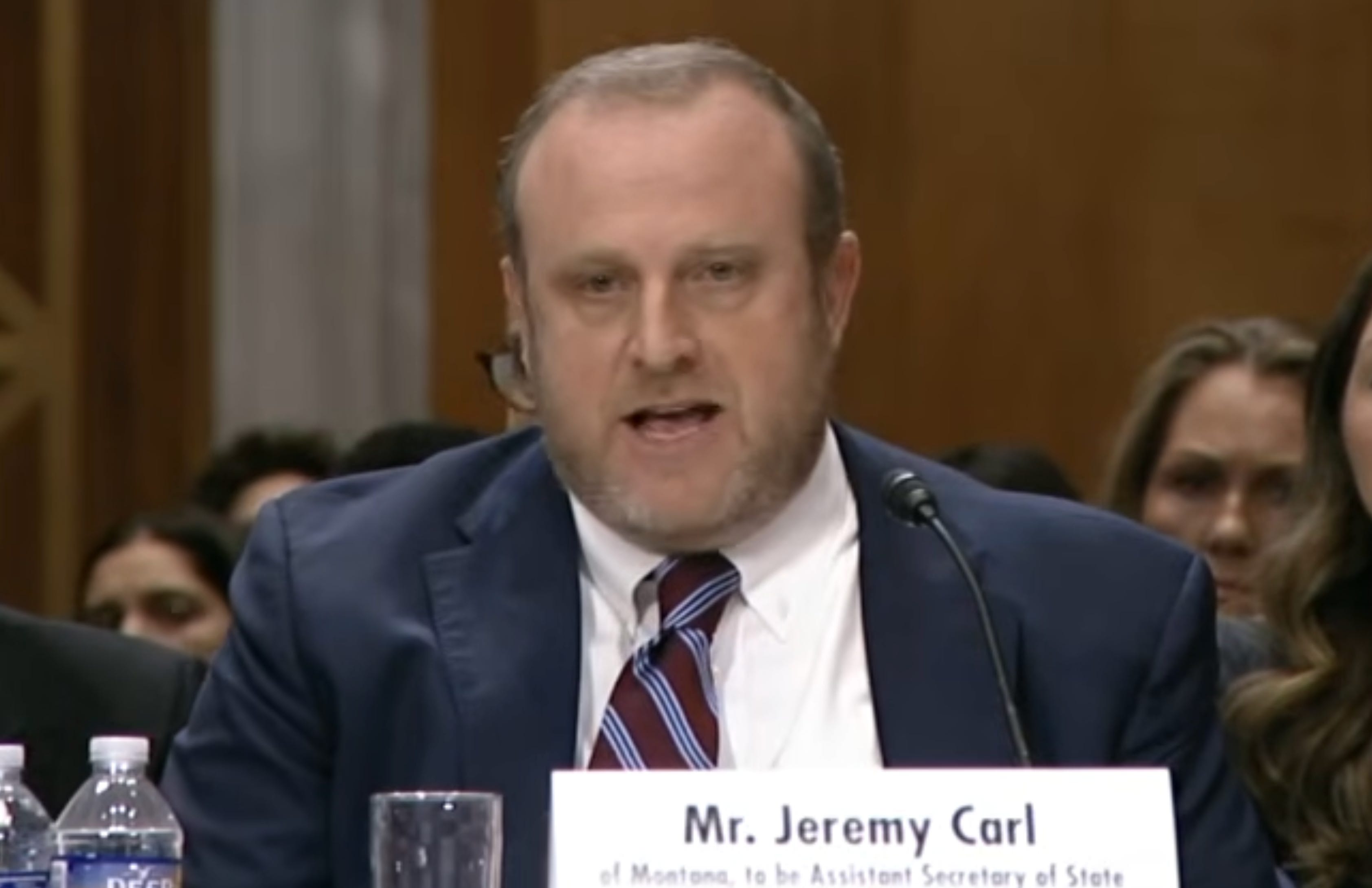
On February 11, the Senate Foreign Relations Committee interviewed Jeremy Carl, Trump’s nominee to run the State Department’s Bureau of International Affairs. If confirmed, Carl—a former Interior Department deputy assistant secretary during Trump’s first term—would be responsible for developing U.S. policy at the United Nations and other multilateral organizations as well as managing more than 100 diplomats around the world.
Carl is a raging antisemite (and racist).
During the hearing, Nevada Democrat Jacky Rosen, cofounder and cochair of the Senate Bipartisan Task Force for Combating Antisemitism, skewered Carl by citing some of his own incendiary comments about Jews that he routinely posted online. They included:
“The Jews love to see themselves as oppressed.”
“I’m very critical on the political stance and sociology of the Jewish community. It has been very destructive overall.”
“The Holocaust dominates so much of modern Jewish thinking, even today. Everyone has traumas in their past. How much are we going to relitigate them?” (Rosen, who is Jewish, reminded the committee that “6 million Jews, almost half the population alive at the time, were slaughtered, [in] an event that continues to be denied to this day.”)
Currently a senior fellow at the rabidly right-wing Claremont Institute, Carl also has repeatedly posted about the “great replacement theory,” the absurd claim that there is a plot, spearheaded by Jews, to intentionally move non-White immigrants to Western countries to “replace” White people. “We must utterly defeat the Great Replacement as a political strategy,” he posted on Twitter in February 2022, “and permanently remove from power all who advance it.”
During the Senate hearing, Carl lamented that “White culture” in the United States is under threat and has previously argued that “White [Christian] Americans are increasingly second-class citizens in a country their ancestors founded.”
Carl, who grew up in a Jewish family before converting to Christianity, did show remorse during the hearing for some of his past antisemitic remarks. “I made some comments in interviews about minimizing the effect of the Holocaust that were absolutely wrong,” he said. “And I’m not going to sit here and defend them.”
Utah Republican John Curtis immediately announced his opposition after the hearing ended, potentially dooming Carl’s nomination. “After reviewing his record and participating in today’s hearing, I do not believe that Jeremy Carl is the right person to represent our nation’s best interests in international forums,” Curtis said in a statement, “and I find his anti-Israel views and insensitive remarks about the Jewish people unbecoming of the position for which he has been nominated.”
But even if the Senate ultimately rejects Carl, he is just the latest Trump antisemitic nominee. Coupled with the antisemitism displayed by Trump himself, his MAGA supporters, and many run-of-the-mill Republican voters—as well as physical attacks on Jews—the steady parade of the president’s antisemitic appointees is making Jewish Americans feel unsafe in their own country.
Antisemites on parade
Besides Carl, some of the more notorious antisemitic Trump appointees include:
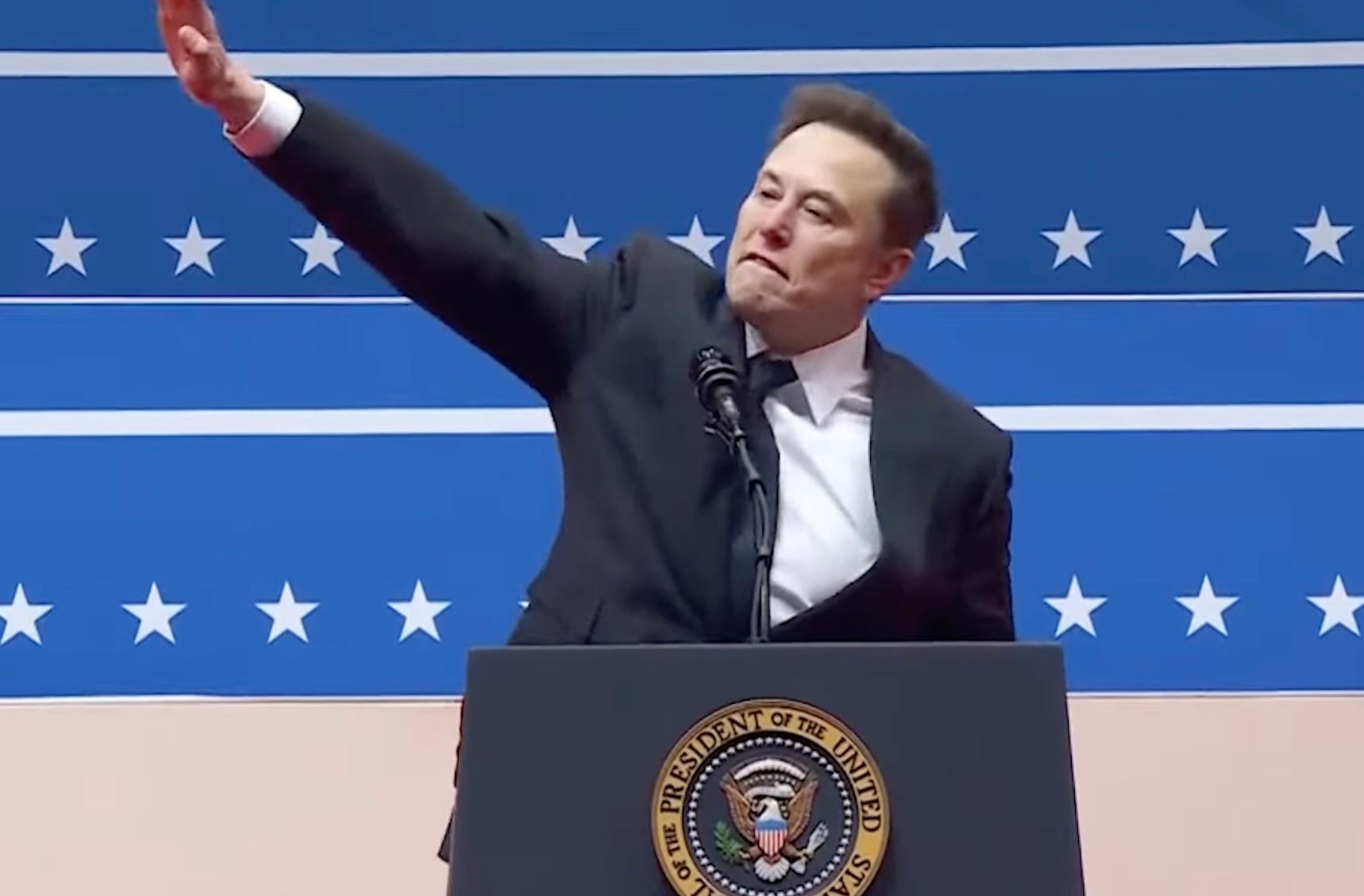
Elon Musk: Let’s start with Elon Musk, who until last May ran Trump’s Department of Government Efficiency. Musk appeared to make a Nazi salute during his speech at Trump’s January 2025 inauguration celebration rally and his social media platform X encourages hate speech. A 2023 study found that antisemitic posts on X more than doubled after he took control of Twitter in October 2022. In November 2023, in response to a post on X that brought up the great replacement theory accusing Jews of “flooding their country” with “hordes of minorities,” Musk replied, “You have said the actual truth.” In response, major corporations, including Apple, Comcast and Disney, stopped advertising on the platform.
Pete Hegseth: Defense Secretary Pete Hegseth supports what he calls a new Christian crusade, which by any other name would be called White Christian nationalism. In May 2025, he hired Kingsley Wilson, who had been working for current Office of Management and Budget Director Russell Vought’s Center for Renewing America, as his deputy press secretary. While she was at the center, she shared conspiratorial posts on X referencing the great replacement theory.
Last July, the Defense Department inked a $200 million contract with Musk’s AI company to begin using Grok, an AI chatbot that has praised Hitler and spewed antisemitic rhetoric. And just last week, Hegseth invited Pastor Doug Wilson to lead a worship service at the Pentagon. A self-described Christian nationalist, Wilson not only thinks America should be ruled as a Christian theocracy, but he also believes women should not be allowed to vote, slaveholders in America were on “firm scriptural ground,” and Jews should convert to Christianity. “The Jews, like every other sinful tribe and nation, must come to Christ,” he writes. “Like all the rest of us, they are lost without Him.”
Paul Ingrassia: It turned out that Trump’s nominee to lead the Office of Special Counsel, Paul Ingrassia, had publicly endorsed white supremacist Nick Fuentes and privately espoused antisemitic rhetoric and bragged that he has a “Nazi streak.” After Ingrassia’s intemperate texts were leaked to the press in October, even Republican senators nixed his nomination, but the administration allowed Ingrassia to remain in his role as the White House liaison for the Department of Homeland Security. When The New York Times asked Trump about Ingrassia in January, Trump said he didn’t know him.
Ed Martin: Trump’s first nominee to serve as the U.S. attorney for Washington, D.C., Ed Martin, had no previous trial or prosecutorial experience. He served in that role for 15 weeks on an interim basis, but could not get Senate approval because of his support for the insurrectionists who stormed the U.S. Capitol on January 6, 2021, as well as his support for Nazi sympathizers. Martin gave an award in August 2024 to white supremacist Timothy Hale-Cusanelli, who said that “Hitler should have finished the job,” and praised Hale-Cusanelli, who sports a Hitler mustache, as an “extraordinary man” and “extraordinary leader.” Martin then became chair of the Justice Department’s Weaponization Working Group, but he didn’t last long there, either. He is now working as the department’s pardon attorney, which keeps him busy.

Trump’s policies match his rhetoric
Trump, who has long flirted with antisemites, racists and White Christian nationalists, has made numerous comments and taken actions that strongly suggest that he is in fact one of them.
There are myriad examples, many of them quite well-known:
In August 2017, Trump said there were “very fine people on both sides” when opining on the clash between White Christian nationalists—who were chanting “Jews will not replace us”—and counterprotesters in Charlottesville, Virginia.
During a 2019 speech to the Israeli American Council, Trump said, “A lot of you are in the real estate business because I know you very well. You’re brutal killers. Not nice people at all. But you have to vote for me. You have no choice.”
In November 2020, Trump dined with noted antisemites Kanye West and Nick Fuentes, a Holocaust denier, at Mar-a-Lago.
Trump routinely accuses Jews of disloyalty and, when addressing Jewish groups, refers to Israel as “your country” and Benjamin Netanyahu as “your prime minister.”
And last July, during a speech in Iowa, Trump described unscrupulous bankers as “shylocks,” a reference to the villainous Jewish moneylender in Shakespeare’s “The Merchant of Venice” who demanded a pound of flesh from a debtor. Trump said he had no idea that the term is considered an antisemitic slur.
Trump’s antisemitic rhetoric is matched by his policies. At the same time his administration withdrew billions of dollars in research grants from universities for allegedly fomenting antisemitism when its actual goal was to stifle anti-Israel protests and punish “left-leaning” institutions, it slashed vital federal funding for combating antisemitism. For example, the administration:
Froze funding for the Nonprofit Security Grant Program, which helps protect synagogues, day schools, Jewish community centers and other places of worship from attacks.
Canceled grants for programs that prevent hate crimes against Arab, Jewish and Asian Americans.
Fired half the staff in the Education Department’s Office for Civil Rights, which enforces Title VI complaints about antisemitism on campus.
Eliminated the Department of Homeland Security program designed to thwart lone-wolf terrorist attacks.
Younger Republicans don’t like Jews
It is difficult to measure just how much Donald Trump and his appointees’ bigoted comments have infected the general public, but recent media reports and surveys suggest that a substantial number of younger Republicans are following their lead.
Last fall, Politico rocked GOP World when it obtained 2,900 pages of private Telegram chats among Young Republican organization leaders in Arizona, Kansas, New York and Vermont from early January to mid-August 2025 and published examples of their vile racist and antisemitic comments. The 11 participants joked about gas chambers and spoke freely about hard-right Republicans’ love for Nazis. One even wrote “I love Hitler.”
When asked about their comments, Vice President JD Vance chalked it up to youthful exuberance. “The reality is that kids do stupid things, especially young boys,” Vance said on “The Charlie Kirk Show.” “They tell edgy, offensive jokes. That’s what kids do.”
Kids? The ages of eight of the participants in the chats ranged from 24 to 35, according to public records and media reports reviewed by Mother Jones magazine. (The ages of three others were not publicly available.)
No matter how despicable, one could argue that the Telegram chats represent the views of only relative handful of Young Republican group leaders. But two recent public opinion polls found that a substantial percentage of Republicans under 50 share negative opinions about Jews.
Researchers at the Jerusalem Center for Security and Foreign Affairs released a survey of Republicans earlier this month that asked respondents how much immigrants, Muslims and Jews pose a danger to “the American way of life.” They split responses into two groups: Republicans 45 and older and party members 44 and younger.
Respondents were significantly more concerned about immigrants and Muslims than Jews, and there was not a substantial difference between the two age groups regarding the threat they perceived from those two groups. But there was a distinct gap between older and younger Republicans when it came to Jews, what the researchers called a “generational shift.” Only 23 percent of Republicans 45 or older believe Jews pose “a great deal” or “a lot” of danger, while 45 percent of Republicans 44 and under think so. The survey also found that “younger Republican voters show significantly higher support” for public figures who are openly “hostile to Jews and Israel.”
A December survey of 2024 Trump voters by the libertarian Manhattan Institute likewise found a pronounced age divide in attitudes about Jews and Israel. The survey labeled respondents “anti-Jewish” is they self-identified as racist and antisemitic or believed that the Holocaust was exaggerated and that Israel is a “settler-colonial state.” It found that only 4 percent of respondents over 50 openly expressed antisemitic views, while 25 percent of respondents under 50 did.
“These findings underscore a recurring pattern: Younger and newer members of the GOP coalition contain a frustrated, alienated subset that is often hostile toward institutions and norms—but not reliably conservative,” the Manhattan Institute researchers concluded. “Some are far-right or otherwise ideological, but many are not conservative at all.”
The frustration and alienation younger Republicans are experiencing make it easier for Trump and his acolytes, whose professed goal is to rip down institutions, to manipulate them by scapegoating Jews, Muslims, Blacks, Latinos and immigrants, not to mention gays and transexuals.

American Jews don’t feel safe
On top of the Trump administration’s pronounced antisemitic bias, American Jews were profoundly rattled by three high-profile attacks on Jews last year. The American Jewish Committee’s (AJC) annual “State of Antisemitism in America” report, released on February 10, found that 91 percent of Jewish Americans now feel less safe largely due to last year’s arson attack on Pennsylvania Gov. Josh Shapiro’s residence; the firebombing of Jewish demonstrators in Boulder, Colorado; and the murder of a young couple outside the Capitol Jewish Museum in Washington, D.C. Meanwhile, 86 percent say antisemitism has worsened in the two years following the October 2023 Hamas attack on Israel and Israel’s response—as if American Jews were responsible.
The AJC report also found that 55 percent of American Jews say they have altered their behavior out of the fear of antisemitism and 17 percent have considered leaving the United States in the past five years, an increase from 13 percent in last year’s report.
“We need Americans to wake up to the reality of what their Jewish neighbors are experiencing,” said AJC CEO Ted Deutch in a press release. “Right now, in America, when Jews gather, whether at synagogue or a community event, it’s routinely behind metal detectors and armed guards. No one in America should have to change their behavior because of what they believe, but that’s how most Jews are living their lives. What we’re asking for is what every other minority group expects in America: the freedom to be who we are without fearing for our safety.”
Elliott Negin the executive editor of Money Trail.
Money Trail, a fiscally sponsored project of the Alternative Newsweekly Foundation, a 501(c)(3) public charity, EIN 30-0100369, is celebrating its first anniversary this month and needs your support to continue to provide stories the mainstream press largely ignores. With your tax-deductible donation, we can expand our reach, hire more reporters, and cover more topics. To make a donation, click on the button below.